
Magnetic Drive Pumps
How They Work and When to Choose Them
Magnetic Drive Pumps: How They Work and When to Choose Them
Every mechanical seal, no matter how well engineered, is a compromise: a contact point between a rotating and a stationary part that will eventually fail. In a plant handling hydrofluoric acid, chlorinated solvents or toxic fluids, “eventually” is not acceptable.
Magnetic drive pumps eliminate the problem at its source. There is no mechanical seal, no contact point, no possibility of leakage. Motion is transmitted to the impeller through a magnetic field that passes through a sealed containment barrier, keeping the fluid completely isolated from the outside environment.
This technical guide explains how magnetic drive pumps work, analyses the real advantages and limitations of the technology, and helps identify the applications where magnetic coupling is the safest and most cost-effective choice.
How it works: transmitting motion without contact
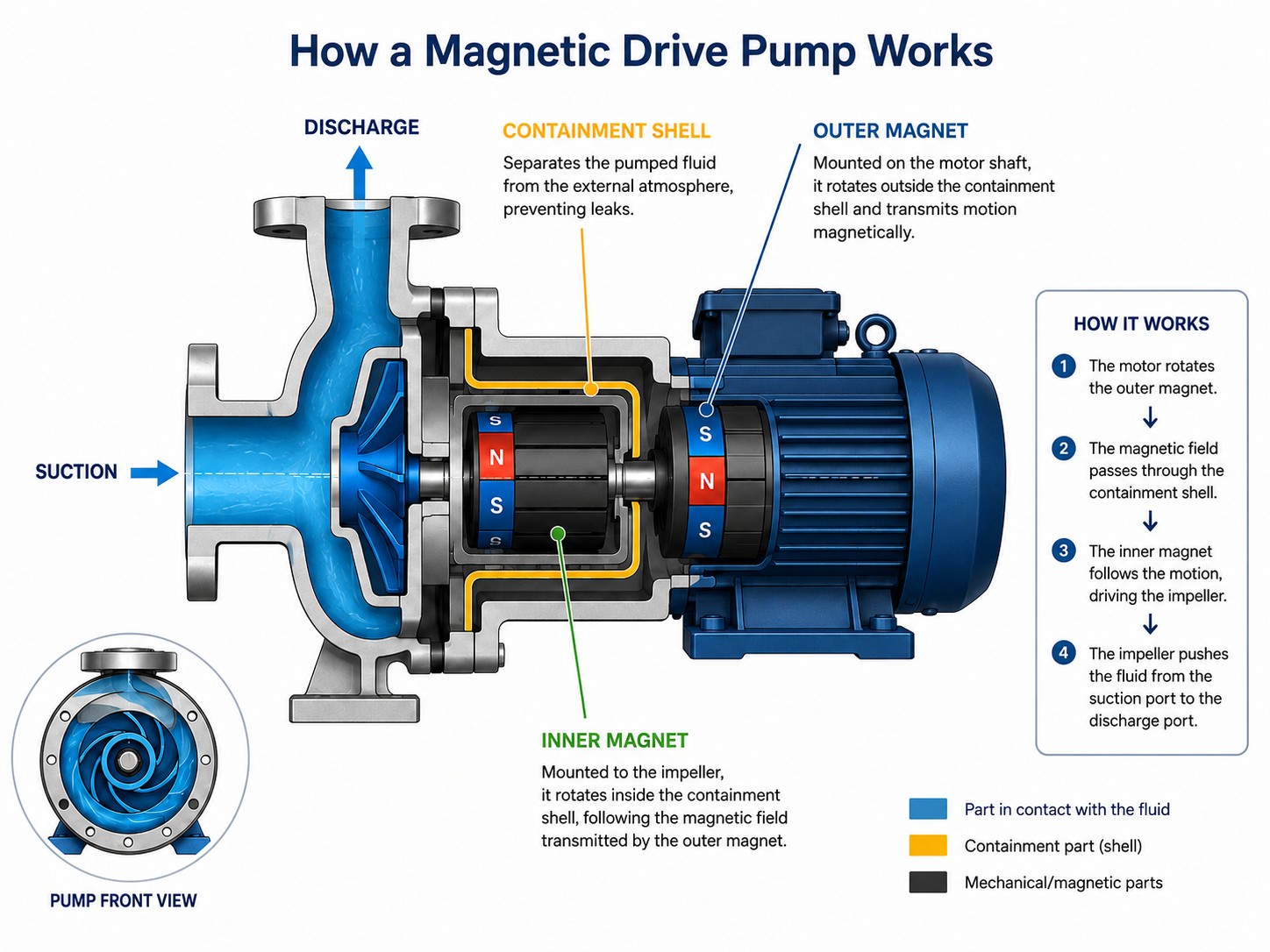
The heart of a magnetic drive pump is the coupling system that replaces the traditional shaft seal. The mechanism is elegant in its simplicity.
The three key components
The system consists of three main elements. The outer magnet (or drive magnet) is connected to the electric motor shaft and rotates outside the pump casing. The inner magnet (or driven magnet) is attached to the impeller and is immersed in the pumped fluid. Between the two sits the containment shell, a sealed barrier made of non-magnetic material that physically separates the drive side from the hydraulic side.
How the drive works
When the electric motor rotates the outer magnet, the magnetic field passes through the containment shell wall and sets the inner magnet in rotation, which in turn drives the impeller. There is no physical contact between the dry side (motor) and the wet side (fluid). The only barrier between the fluid and the outside environment is the containment shell — a completely static component with no mechanical wear.
This principle guarantees an absolute hermetic seal for the entire service life of the pump, with no need for adjustments, periodic replacements or external lubrication.
The role of the containment shell
The containment shell is the most critical component from a design standpoint. It must be made of a material that simultaneously meets three requirements: magnetic transparency (it must not attenuate the field), chemical resistance to the pumped fluid, and mechanical strength to withstand internal pressure.
In metallic magnetic drive pumps, the containment shell is typically made of Hastelloy or austenitic stainless steel, but these materials generate eddy currents that reduce efficiency and heat the fluid. In thermoplastic pumps such as Nuova Darimpianti’s HTM series, the containment shell is made of engineering plastic, which generates no eddy currents and offers excellent chemical resistance. The result is superior magnetic efficiency and zero induced heating of the fluid.
Real advantages over mechanically sealed pumps
Choosing a magnetic drive pump goes beyond simply eliminating the mechanical seal. The advantages extend to plant safety, operating costs and process quality.
Zero fugitive emissions
European and international safety regulations (ATEX Directive, EPA Method 21, ISO 15848) impose increasingly stringent limits on fugitive emissions. Every mechanical seal is a potential emission source. Magnetic drive pumps, having no shaft penetration through the pump casing, meet the most restrictive regulations without the need for additional monitoring systems.
In ATEX-classified environments (zones with potentially explosive atmospheres), the absence of any leakage point drastically reduces ignition risk and simplifies risk assessment.
Reduced maintenance costs
The mechanical seal is the component that requires the most maintenance in a centrifugal pump. Replacing it involves plant downtime, partial pump disassembly and specialised personnel. In applications with concentrated acids, a mechanical seal typically lasts between 6 and 18 months.
By eliminating the mechanical seal, a magnetic drive pump reduces scheduled maintenance shutdowns, eliminates the need to stock seal spare parts, cuts technical intervention costs and extends the intervals between general overhauls. The slightly higher initial cost of a magnetic drive pump is typically recovered within 12–24 months through maintenance savings.
No fluid contamination
In mechanically sealed pumps, the seal faces release microscopic wear particles into the pumped fluid. In pharmaceutical applications, ultra-pure water treatment and semiconductor manufacturing, this contamination is unacceptable.
Magnetic drive pumps, having no sliding parts in contact with the fluid (except for the impeller support bearings), deliver a significantly higher level of fluid purity.
No barrier fluid consumption
Double mechanical seal pumps (such as Nuova Darimpianti’s PMC-2 series) require a barrier fluid that must be compatible with the process fluid, maintained at constant pressure and periodically topped up or replaced. The magnetic drive pump eliminates this requirement entirely, simplifying installation and reducing consumables.
Limitations and precautions: when a magnetic pump is not the right choice
No technology is universal. Magnetic drive pumps have specific limitations that must be carefully evaluated during the selection process.
The dry-running risk
The most critical limitation of magnetic drive pumps is their sensitivity to dry running. The internal bearings of the impeller are lubricated and cooled by the pumped fluid. If the pump operates without fluid, even for a few minutes, the bearings overheat and sustain damage, and in the worst cases the magnets lose their magnetic properties due to heat (demagnetisation).
To prevent this, it is essential to install level sensors in the suction vessel, provide dry-run protection (such as a thermal relay or flow sensor), and never start the pump with the discharge valve closed without a bypass line.
Transmissible torque and decoupling
The magnetic coupling has a maximum transmissible torque limit. If the fluid resistance exceeds this limit — due to a sudden blockage in the discharge line, excessive fluid viscosity or a foreign body in the impeller — the magnets “slip” and motion transmission stops. This phenomenon, known as magnetic decoupling, protects the motor from overload but requires manual intervention to restore operation.
For applications with viscous fluids (above 200–300 cP) or frequent sudden load variations, a mechanically sealed pump may be more appropriate.
Head and power
At the same size and motor power, magnetic drive pumps generally develop lower head than mechanically sealed pumps. This is because part of the energy is dissipated in the magnetic coupling (especially in metallic containment shells, less so in plastic versions). For applications requiring high head, a larger pump size must be selected.
Temperature and suspended solids
Permanent magnets lose magnetic strength as temperature increases. Above 200°C (in metallic versions) or 100°C (in plastic versions), transmissible torque decreases significantly. Additionally, fluids with suspended solid particles can damage internal bearings more rapidly than in a mechanically sealed pump.
Ideal applications for magnetic drive pumps
Magnetic coupling is the technically superior choice wherever the priority is absolute zero leakage. Here are the applications where this technology delivers the greatest value.
Chemical and petrochemical industry
Pumping concentrated acids (sulfuric, hydrochloric, hydrofluoric), chlorinated solvents, strong bases and toxic reagents is the classic application for magnetic drive pumps. Safety regulations classify many of these fluids as hazardous substances whose release must be prevented by all technically available means.
Surface treatment and electroplating
In electroplating plants, tanks contain acid and alkaline solutions at controlled temperatures that must be transferred without contamination or leakage. The magnetic drive pump is ideal for recirculation and transfer between galvanic baths based on chromic acid, sulfuric acid and hydrofluoric acid.
Pharmaceutical and food industry
Pumped fluid purity is a non-negotiable requirement. Magnetic drive pumps, releasing no particles from seals, meet the requirements of processes where contamination must be reduced to zero.
Water treatment and scrubbers
Dosing and transferring chemical reagents (sodium hypochlorite, sulfuric acid for pH correction, polyelectrolytes) in water treatment plants requires reliable, leak-free pumps — especially in outdoor installations or unattended facilities (see VSK pumps series).
Semiconductor manufacturing
The ultra-pure water and chemical reagents used in chip production must be transferred without any ionic contamination. PVDF magnetic drive pumps are the industry standard for these applications.
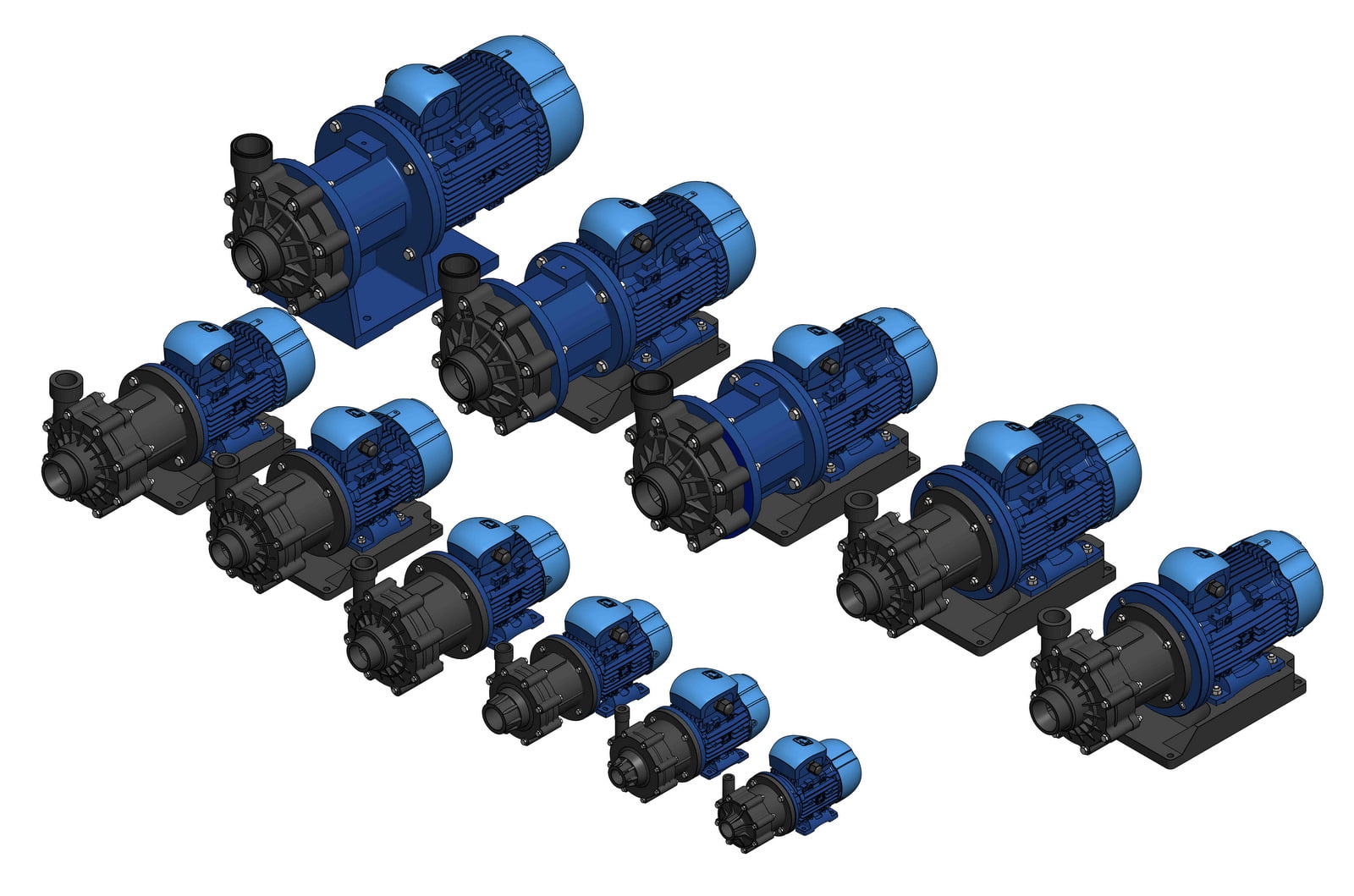
Nuova Darimpianti’s HTM series: magnetic drive in thermoplastic
The HTM series is the horizontal centrifugal magnetic drive pump designed and manufactured by Nuova Darimpianti specifically for corrosive and hazardous fluids.
Solid-block CNC construction
Unlike most magnetic drive pumps on the market, which are produced by injection moulding, the HTM series is manufactured by solid-block machining: every component — pump casing, impeller, containment shell — is machined from a solid block of polymer on 3-axis and 5-axis CNC machining centres.
This manufacturing method ensures no residual internal stresses in the material (which in moulded parts can cause cracking under chemical stress), precision dimensional tolerances that guarantee optimal coupling between magnets and containment shell, and uniform controlled wall thickness that maximises internal pressure resistance.
Available materials
The HTM series is available in three thermoplastic materials. Polypropylene (PP) is suitable for dilute acids, saline solutions and bases at temperatures up to 80°C — the most economical choice for non-oxidising fluids. PVC is ideal for sodium hypochlorite and ambient-temperature solutions up to 60°C. PVDF offers the highest chemical resistance for concentrated acids, solvents and oxidising fluids up to 100°C.
Key technical features
The HTM series covers flow rates from a few litres per minute up to significant industrial volumes, with head values suited to transfer and recirculation applications. The engineering-plastic containment shell eliminates the eddy current losses typical of metallic shells, improving overall pump efficiency.
Every HTM pump can be custom-configured for connection sizes, material type and motor power, thanks to the flexibility of solid-block CNC manufacturing.
Magnetic drive vs mechanical seal: a practical decision guide
The choice between magnetic coupling and mechanical seal is not always straightforward. Here are the practical criteria to guide the decision.
Choose the magnetic drive pump (HTM) when: the fluid is toxic, carcinogenic or highly hazardous; regulations require zero fugitive emissions; the fluid tends to crystallise (crystallisation destroys mechanical seals); the plant is not continuously manned and leakage cannot be tolerated; mechanical seal maintenance costs are excessive.
Choose the mechanically sealed pump (PMC-1 or PMC-2) when: high head is required that the magnetic version cannot achieve; the fluid contains suspended solids that would damage magnetic pump bearings; the temperature exceeds magnet limits; frequent load variations or unstable process conditions occur; fluid viscosity exceeds 200 cP.
Intermediate solution — double flushed seal (PMC-2): if the fluid is hazardous but operating conditions are not compatible with a magnetic drive pump, the PMC-2 series with double flushed seal offers a high level of safety, with the barrier fluid acting as an additional defence against leakage.
Frequently asked questions
What is the main difference between a magnetic drive pump and a mechanically sealed pump?
The fundamental difference is that in a magnetic drive pump there is no shaft penetration through the pump casing. Motion is transmitted through a magnetic field that passes through a sealed wall (the containment shell). This completely eliminates leakage risk, which in mechanically sealed pumps depends on the integrity of the seal faces.
Do magnetic drive pumps consume more energy?
In versions with a metallic containment shell, yes: eddy currents cause a power loss of 5–15%. In pumps with a plastic containment shell, such as Nuova Darimpianti’s HTM series, magnetic losses are negligible and efficiency is comparable to mechanically sealed pumps.
What happens if a magnetic drive pump runs dry?
Dry running is the primary risk for magnetic drive pumps. Without fluid to lubricate the internal bearings, rapid overheating occurs which can damage the bearings and, in severe cases, demagnetise the magnets. Dry-run protection (level sensors, thermal relays, flow sensors) is essential.
Which fluids are recommended for magnetic drive pumps?
Any fluid where a leak would be unacceptable: concentrated acids (sulfuric, hydrochloric, hydrofluoric, nitric), toxic solvents, carcinogenic fluids, expensive reagents, crystallising fluids and pharmaceutical solutions requiring absolute purity.
Can the HTM series be customised?
Yes. Being manufactured from solid blocks via CNC machining, the HTM series can be configured for material (PP, PVC, PVDF), connection sizes, flow rate and head. Nuova Darimpianti engineers custom solutions for specific plant requirements.
The safe choice for fluids that allow no compromise
Magnetic drive pumps are not the solution for every application, but when the fluid is hazardous, toxic or corrosive and zero leakage is not optional but a requirement, they represent the most reliable technology available.
Nuova Darimpianti’s HTM series combines the magnetic drive principle with solid-block CNC machining in thermoplastic materials, delivering a leak-free, corrosion-resistant pump built to precision tolerances that surpass moulded alternatives.