
How to Choose an Industrial Agitator
Practical Sizing Guide
How to Choose an Industrial Agitator: A Practical Sizing Guide
Choosing an industrial agitator is not simply a matter of buying a motor with a propeller. An undersized agitator will leave dead zones in the tank where the product remains unmixed, causing process defects.
An oversized agitator will waste energy, generate excessive vibrations and shorten the service life of bearings and shaft.
Correct sizing requires a systematic analysis that starts from the fluid properties and process conditions and works towards the choice of impeller, rotational speed and motor power.
This technical guide covers every step of the selection process, with reference to the agitator series manufactured by Nuova Darimpianti for corrosive environments.
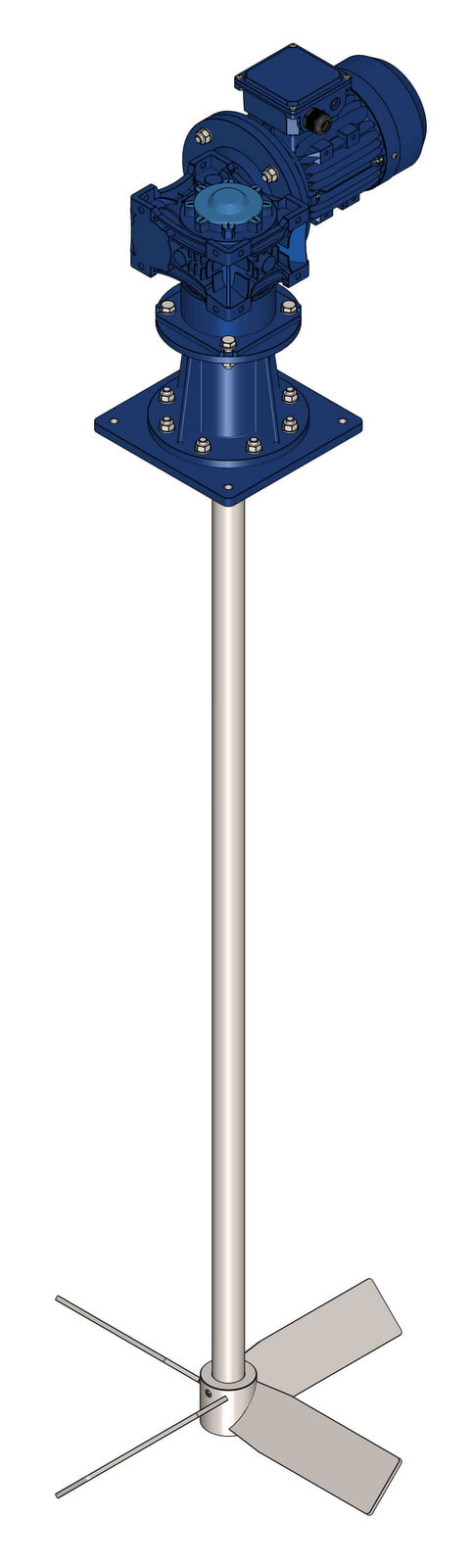
Starting point: what the agitator needs to achieve
Before discussing impellers and motors, it is essential to clearly define the purpose of the agitation process. Different operations require very different approaches.
Homogeneous blending is the most common operation: uniformising the composition of a liquid within the tank, typically after a reagent addition. It requires good circulation of the entire volume with moderate turbulence.
Solid suspension requires the agitator to generate sufficient fluid velocity to prevent solid particles from settling on the tank bottom. The power needed depends on particle density and size distribution.
Gas-liquid dispersion applies to processes such as aeration in biological treatment or chemical reactions with gaseous reagents. It requires high-turbulence impellers capable of breaking gas bubbles into microbubbles to maximise the exchange surface area.
Heat transfer requires the agitator to maintain a constant flow along the tank walls where cooling or heating coils or jackets are installed.
Emulsification (creating stable liquid-liquid emulsions) requires high shear forces to reduce the droplet size of the dispersed phase.
Clearly defining the objective is the first step: the required flow pattern, the most suitable impeller and the power demand all follow from it.
The fluid properties that drive the selection
The two physical properties that most influence agitator sizing are viscosity and density.
Viscosity: the dominant parameter
Viscosity measures a fluid’s internal resistance to flow. A low-viscosity fluid such as water (1 cP) behaves radically differently from a heavy oil (10,000 cP) or a resin (100,000 cP).
For low-viscosity fluids (1–100 cP), such as aqueous solutions, dilute acids and solvents, the flow regime is easily turbulent and agitation is relatively straightforward. Small-diameter, high-speed impellers are sufficient (D/T ratio between 0.2 and 0.4, where D is the impeller diameter and T the tank diameter).
For medium-viscosity fluids (100–10,000 cP), such as concentrated suspensions, emulsions and polymer solutions, the transitional regime makes mixing more complex. Larger-diameter impellers (D/T between 0.4 and 0.6) at intermediate speeds are required.
For high-viscosity fluids (above 10,000 cP), such as pastes, gels, adhesives and resins, the regime is laminar and conventional impellers become ineffective. Large-diameter impellers that approach the tank walls (D/T between 0.6 and 0.95), such as anchors or helical ribbons, operating at very low speeds are needed.
Density: the effect on power
The fluid density (expressed in kg/m³) directly affects the power drawn by the agitator. All other parameters being equal, doubling the density doubles the required power. For concentrated acids (density 1,400–1,840 kg/m³ for sulfuric acid) the power demand is significantly higher than for aqueous solutions.
Rheological behaviour
Many industrial fluids do not have a constant viscosity — they are non-Newtonian fluids. Some become less viscous when agitated (pseudoplastic or shear-thinning fluids), others become more viscous (dilatant or shear-thickening fluids), and others have a yield stress that must be exceeded before the fluid moves (Bingham plastic fluids). Understanding the rheological behaviour is essential for correct agitator sizing.
The rotational Reynolds number: the sizing compass
The parameter that links fluid properties to agitator operating conditions is the rotational Reynolds number, defined as:
Re = (ρ × N × D²) / μ
where ρ is the fluid density (kg/m³), N the impeller rotational speed (revolutions per second), D the impeller diameter (m) and μ the dynamic viscosity (Pa·s).
The Reynolds number determines the flow regime inside the tank. At Re < 10, the regime is laminar: the fluid moves in ordered layers and mixing occurs mainly by molecular diffusion. At 10 < Re < 10,000, the regime is transitional: laminar and turbulent zones coexist, and mixing is uneven. At Re > 10,000, the regime is fully turbulent: mixing is rapid and efficient, with optimal mass and heat transfer.
The sizing objective is to select the impeller-speed combination that brings the Reynolds number into the desired regime for the specific process. For homogeneous blending in turbulent conditions, Re > 10,000 is the minimum target.
Impeller types: axial, radial and tangential flow
The impeller is the heart of the agitator. Its geometry determines the type of flow generated in the tank and, consequently, the effectiveness of the mixing process.
Axial flow impellers
Axial flow impellers drive the fluid parallel to the agitator shaft, generating a large recirculation loop that involves the entire tank volume. They are the most efficient for homogeneous blending and solid suspension, because they move large fluid volumes with relatively low energy consumption.
The main types include the three-blade marine propeller, the classic choice for low to medium-viscosity fluids. Nuova Darimpianti’s EV series features three-blade marine propeller impellers in PP, PVC or PVDF for corrosive environment applications, with rotational speeds up to 1,400 rpm. It is the quintessential high-speed agitator, ideal for blending, neutralisation and dilution tanks for acids and bases.
Pitched blade impellers combine a dominant axial component with a radial component, offering versatility in applications requiring both circulation and a degree of localised turbulence.
Radial flow impellers
Radial flow impellers drive the fluid perpendicular to the agitator shaft, towards the tank walls. They generate high shear forces in the zone immediately surrounding the impeller, making them ideal for gas-liquid dispersion, emulsification and solid dissolution.
The Cowles impeller (or sawtooth disc) is a disc with a serrated perimeter that generates an intense shear zone. It is the preferred choice for pigment dispersion in paints, emulsion preparation and mixing of fluids with very different viscosities. Nuova Darimpianti’s EVK series features Cowles-type impellers for applications requiring high shear in corrosive environments.
Flat blade turbines (Rushton type) generate intense radial flow and are the standard for gas-liquid dispersion in chemical reactors and bioreactors.
High-viscosity impellers
For high-viscosity fluids, conventional impellers (axial and radial) cannot generate adequate flow because turbulence does not propagate far from the impeller. In these cases, large-diameter impellers such as anchors and helical ribbons are used, operating at very low speeds (5–50 rpm) but involving the entire tank volume due to their proximity to the walls.
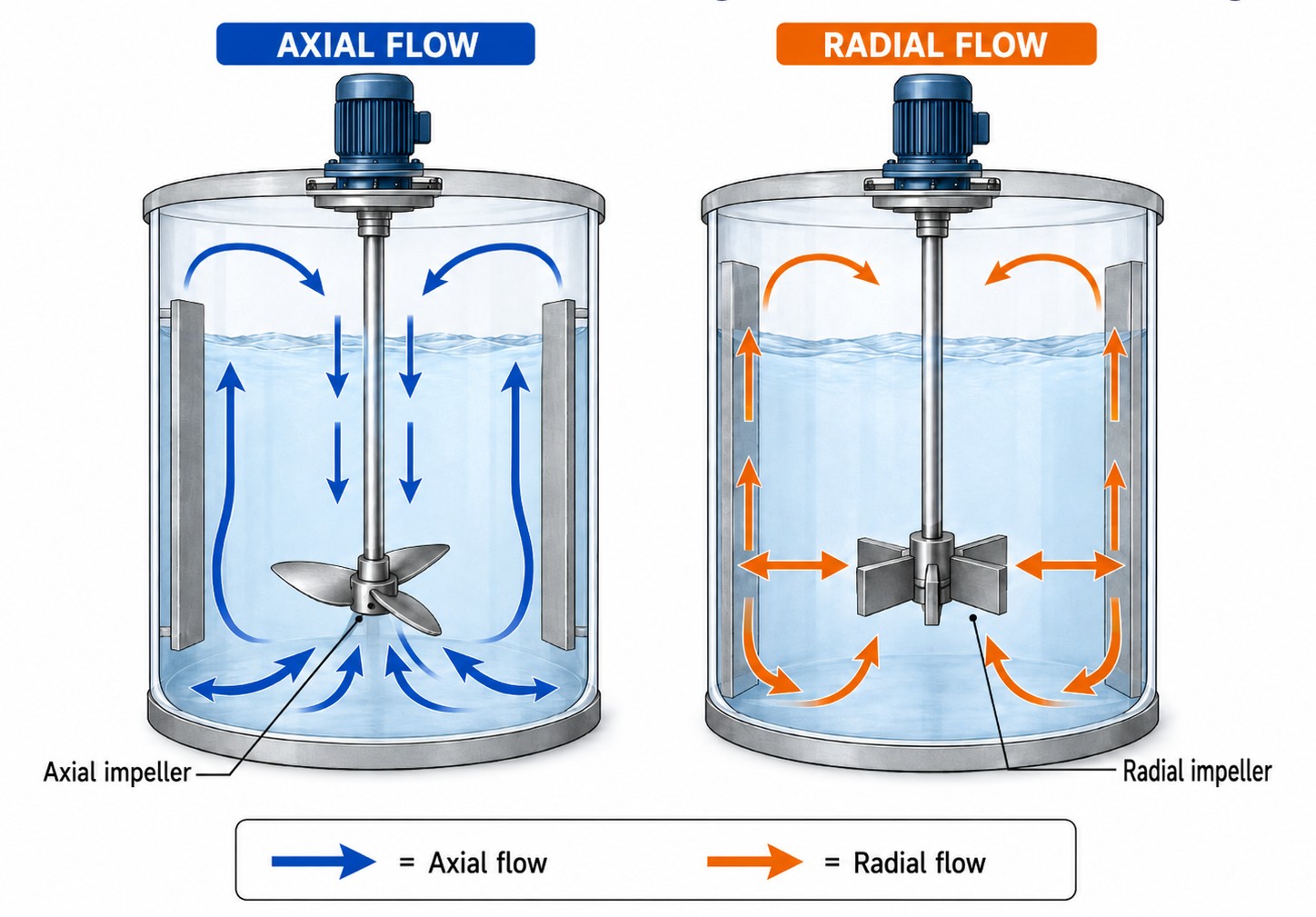
Axial and radial flow patterns in industrial mixing
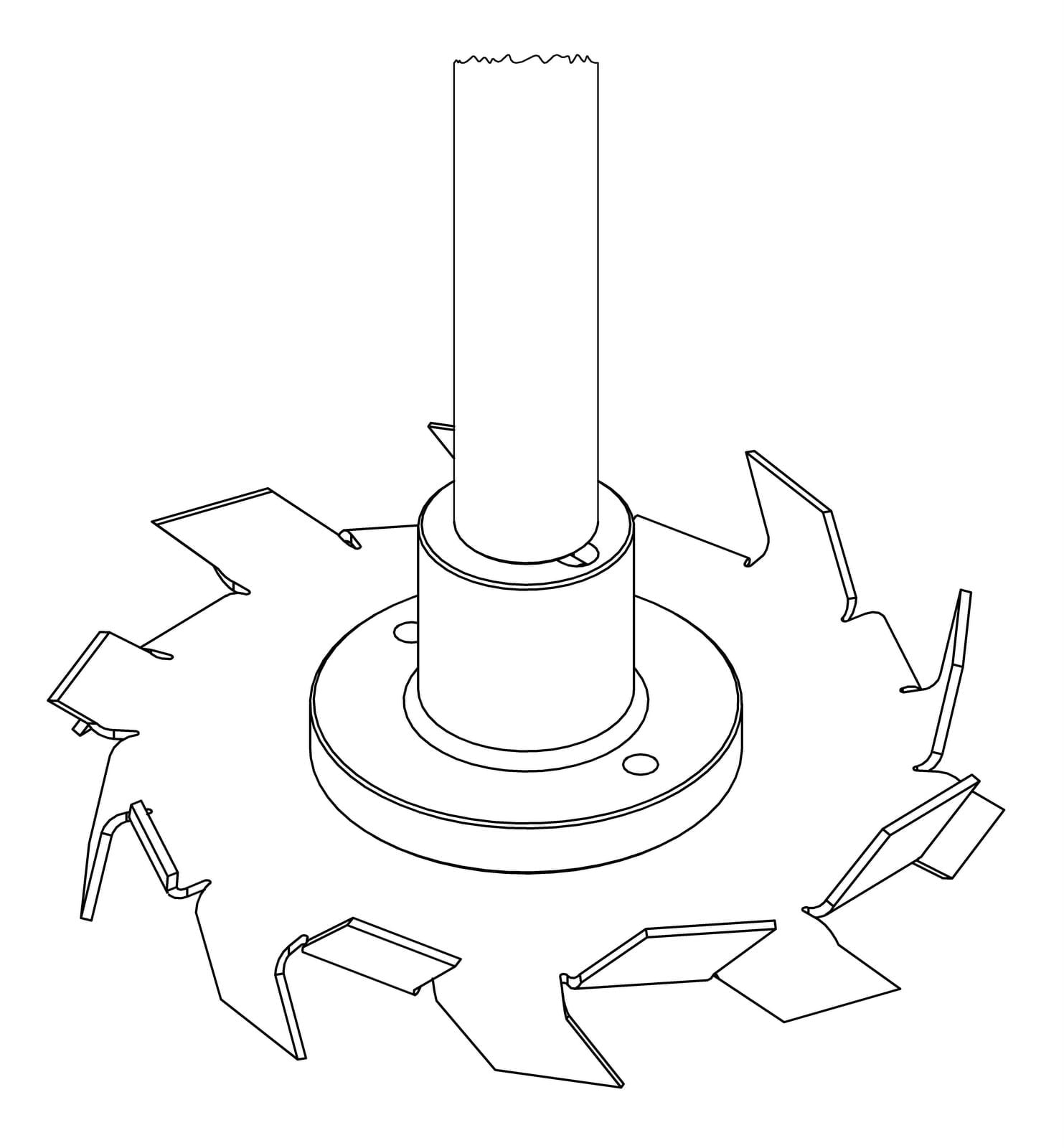
Three-blade marine propeller impeller in PVDF for EV high-speed agitator
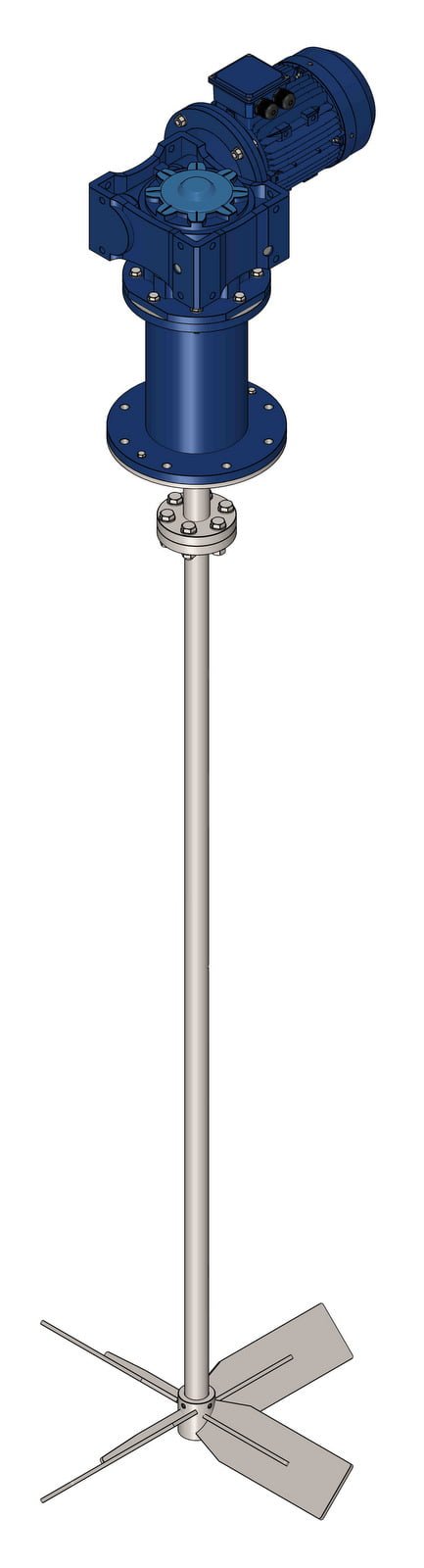
High-speed and low-speed agitators: the Nuova Darimpianti range
Nuova Darimpianti classifies its agitators into two main families based on rotational speed, each designed for a specific application range.
High-speed series: EV, EVK, EVL, KVL
High-speed series agitators operate at high rotational speeds (typically 300 to 1,400 rpm) and feature impellers with a relatively small diameter compared to the tank.
The EV series is the standard high-speed agitator with a three-blade marine propeller impeller, ideal for homogeneous blending, dilution and neutralisation of low to medium-viscosity fluids. The EVK series features a Cowles-type impeller for high-shear applications such as pigment dispersion and emulsion preparation. The EVL series is the extended-shaft version for deep tanks. The *KVL series is the variant with an integrated epicyclic gear reducer for applications requiring higher torque at intermediate speed.
All high-speed models are available with shaft and impeller in PP, PVC, PVDF or AISI 316 stainless steel, and can be fitted with a three-phase electric or pneumatic motor.
Low-speed series: EVR, EVRK, EVRL, KVRL
Low-speed series agitators operate at reduced rotational speeds (5 to 380 rpm via a mechanical gear reducer) and feature larger-diameter impellers, generating a gentler but more penetrating flow throughout the tank volume.
The EVR series is the standard low-speed agitator with a four-blade pitched impeller, designed for gentle blending, suspension maintenance and slow recirculation of shear-sensitive fluids. The EVRK series features a Cowles-type impeller on a low-speed drive for applications requiring both a degree of shear and a long residence time. The EVRL series is the extended-shaft version. The KVRL series integrates an epicyclic gear reducer for high torque at very low speeds.
The low-speed series application range spans viscous solutions to suspensions with heavy solids, from electroplating to water treatment.
Side-entry series: LVO and LRO
For large-volume tanks where top-entry installation is not practical, Nuova Darimpianti offers side-entry agitators mounted on the tank wall. The LVO series is the high-speed version; the LRO series is the low-speed version with gear reducer. Both generate a helical flow pattern inside the tank that ensures effective mixing even in large-diameter cylindrical vessels.
Practical sizing: the parameters to define
Once the impeller type has been chosen, agitator sizing requires the determination of four fundamental parameters.
1. Impeller diameter
The D/T ratio (impeller diameter / tank diameter) is the first parameter to establish. For high-speed agitators with axial flow impellers, the typical ratio is 0.25–0.40. For low-speed agitators with pitched blade impellers, the ratio rises to 0.40–0.65. For anchor or ribbon impellers, it reaches 0.90–0.98.
2. Rotational speed
Speed is chosen based on the desired Reynolds regime and impeller type. High-speed impellers (propellers, turbines) operate between 300 and 1,400 rpm. Low-speed impellers (pitched blades) between 20 and 380 rpm. High-viscosity impellers between 5 and 50 rpm.
3. Motor power
The required power is calculated through the power number (Np), a dimensionless coefficient characteristic of each impeller type:
P = Np × ρ × N³ × D⁵
where P is power (W), Np the impeller power number, ρ the fluid density (kg/m³), N the rotational speed (rev/s) and D the impeller diameter (m).
The power number varies by impeller type: for a three-blade marine propeller it is approximately 0.3–0.5 in the turbulent regime, for a Rushton turbine approximately 4–6, and for a pitched blade impeller approximately 1.2–1.5.
A common mistake is selecting the motor based solely on rated kW. The critical parameter is the shaft torque (expressed in Nm), which determines the agitator’s ability to overcome fluid resistance. For viscous fluids, a powerful motor running at high speed may have less usable torque than a less powerful but slower motor fitted with a gear reducer.
4. Installation position and shaft length
The agitator must be correctly positioned within the tank. For axial flow impellers, the distance from the tank bottom should be approximately one impeller diameter. For tall tanks with a variable level, it may be necessary to install multiple impellers on the same shaft or to use the EVL/EVRL extended-shaft series.
Eccentric installation (with the agitator axis offset from the tank centre) or angled mounting is an effective alternative to baffles for preventing the central vortex in open tanks.
Material selection for corrosive environments
In environments where the fluid is chemically aggressive, the shaft and impeller material must be compatible with the process. Nuova Darimpianti manufactures agitators with shafts and impellers machined from solid blocks on CNC centres in the following thermoplastic materials.
Polypropylene (PP) is the standard choice for dilute acids, bases, saline solutions and electroplating baths up to 80°C. PVC is suitable for sodium hypochlorite and low-temperature solutions. PVDF offers superior chemical resistance for concentrated acids, solvents and oxidising environments up to 100°C. PE-HD (high-density polyethylene) is used for specific low-temperature applications.
Solid-block CNC machining ensures no internal stresses and precise dimensional tolerances — a critical advantage for impellers operating at high rotational speeds where even small imbalances generate excessive vibrations.
Common mistakes in agitator selection
Industry experience reveals several recurring errors in industrial agitator selection.
Selecting the agitator based on motor power rather than analysing the process. A 5 kW agitator with the wrong impeller can mix worse than a 1.5 kW unit with the correct one.
Ignoring viscosity changes during the process. Many processes involve viscosity variations during the cycle (for example during polymerisation or heating). The agitator must be sized for the most demanding condition.
Not accounting for variable tank level. If the tank is filled and emptied while the agitator is running, the impeller may be exposed above the liquid during low-level phases, causing vibrations, unwanted aeration and accelerated wear.
Underestimating the effect of baffles. In cylindrical tanks with axial impellers, the absence of baffles causes a central vortex that drastically reduces mixing effectiveness and can entrain air into the fluid.
For more information on suitable materials, see our guide to Corrosive Acid Pumps and the article on magnetic drive pumps.
Domande frequenti
What is the difference between a high-speed and a low-speed agitator?
A high-speed agitator typically operates between 300 and 1,400 rpm with a small impeller relative to the tank (D/T 0.2–0.4) and generates intense turbulent flow. A low-speed agitator operates between 5 and 380 rpm with a larger impeller (D/T 0.4–0.65) and generates a gentler but more extensive flow. The choice depends on fluid viscosity and the process type: high-speed for rapid mixing of low-viscosity fluids, low-speed for viscous or shear-sensitive fluids.
How do you calculate the power required for an agitator?
Power is calculated using the formula P = Np × ρ × N³ × D⁵, where Np is the impeller power number (a coefficient that depends on geometry), ρ the fluid density, N the speed and D the impeller diameter. The Np value is obtained from experimental correlations specific to each impeller type and Reynolds regime.
What happens if the fluid viscosity changes during the process?
The agitator must be sized for the most demanding condition. If viscosity increases during the process (for example in a polymerisation reaction), the agitator must be capable of generating sufficient torque even at maximum viscosities. A variable frequency drive (VFD) can be useful for adapting speed to different process stages.
Which materials are suitable for agitating acids in electroplating tanks?
For electroplating tanks with dilute acids and metal salt solutions, polypropylene (PP) is the standard choice. For baths containing chromic acid, hydrofluoric acid or strongly oxidising solutions, PVDF is required. Nuova Darimpianti manufactures shafts and impellers in PP, PVC, PVDF, PE-HD and Ebonite, all machined from solid blocks on CNC centres.
Can Nuova Darimpianti size the agitator for my specific application?
Yes. Correct sizing requires information about tank volume, fluid type and properties, process objective and operating conditions. Nuova Darimpianti’s engineering team analyses these data and proposes the optimal combination of series, impeller, material and motor for each application.
Choose the right agitator
Selecting an industrial agitator is a technical process requiring analysis of multiple factors: the process objective, fluid properties, the desired flow regime, tank geometry and operating conditions.
Nuova Darimpianti designs and manufactures high-speed agitators (EV, EVK, EVL, KVL series), low-speed agitators (EVR, EVRK, EVRL, KVRL series) and side-entry agitators (LVO, LRO series) in PP, PVC, PVDF and AISI 316 stainless steel, all with components machined from solid blocks on CNC centres. Every agitator can be custom-configured for the specific requirements of your plant.