
Put two agitators with the same motor and shaft into the same tank and you can still get opposite results. The difference is the impeller. Different agitator impeller types decide how the fluid moves, how much shear reaches droplets, bubbles and agglomerates, and how much motor power becomes useful mixing rather than heat and vortex.
This guide reviews the impellers we fit at Nuova Darimpianti on agitators for corrosive service: marine propeller, Cowles (cowless) disc, Rushton turbine, emulsifier, folding blades, pitched blades, high-flow, anchor and scraper. For each one we cover flow, viscosity, uses and limits. For the full agitator selection process (process objective, Reynolds number, motor), start with how to choose an industrial agitator; here we stay on the impeller.
Axial, radial and tangential flow
Every impeller pushes fluid in a dominant direction, and that direction sets the job it does well.
Axial flow
Axial impellers push liquid parallel to the shaft, usually towards the bottom. The jet rises along the walls and returns to the impeller, forming a single loop that sweeps the whole volume. This is the most efficient pattern for blending, keeping solids suspended and evening out temperature with little power. Marine propellers, pitched blades (mixed flow with an axial bias) and high-flow impellers belong here.
Radial flow
Radial impellers discharge fluid towards the walls, creating two loops above and below the impeller. They pump less liquid per kW but concentrate a lot of shear close to the blades: what you need to disperse powders and pigments, break agglomerates, emulsify or break up a gas. Cowles discs, Rushton turbines and emulsifiers are radial.
Tangential flow
Anchors and scrapers turn slowly with a diameter close to the tank diameter, dragging the fluid round and acting continuously on the wall. You need them when the product is so viscous that a small impeller would only stir a “cavern” of liquid around itself.
In unbaffled cylindrical tanks, fast impellers tend to spin the whole liquid and pull a central vortex. The usual fixes are baffles, off-centre or angled mounting and side-entry agitators. Anchors, by contrast, run without baffles.
Agitator impeller types one by one
Speeds quoted are those on our product datasheets. Viscosity ranges are indicative and should be checked against the real fluid.
Three-blade marine propeller
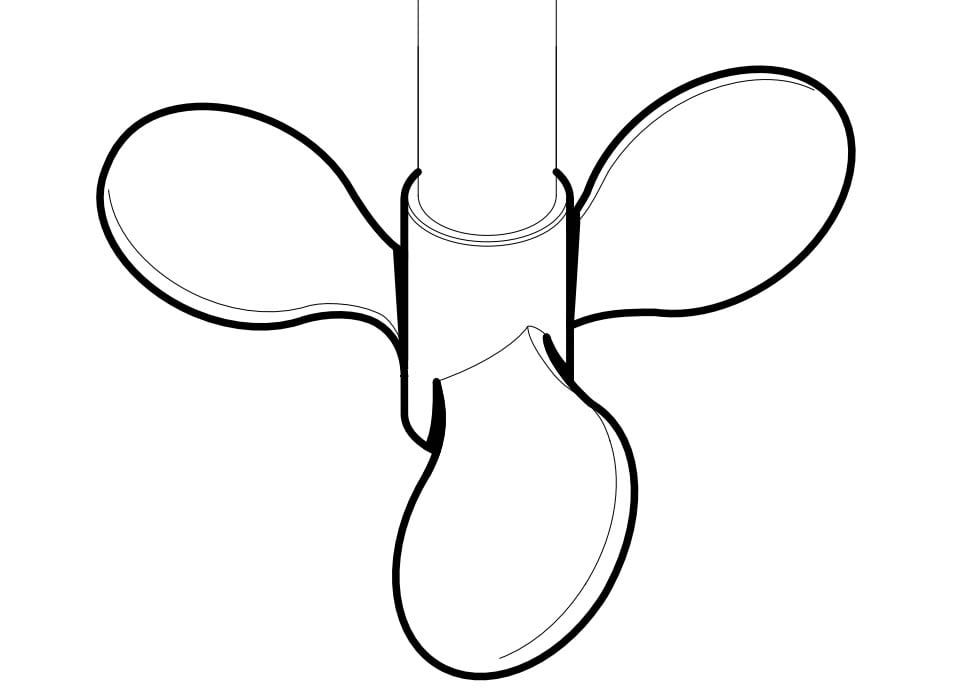
The most common impeller on fast agitators: three helical blades driving liquid towards the bottom with clean axial flow and low power. It runs from 500 to 1,500 rpm and is the standard impeller on the EV and EVK ranges.
- Viscosity: low, up to about 2,000-3,000 cP.
- Typical uses: diluting and neutralising acids and alkalis, preparing solutions, water treatment.
- Strengths: high flow per kW, low vibration.
- Limits: little shear; in viscous fluids the flow dies out near the impeller.
Cowles (cowless) disc impeller
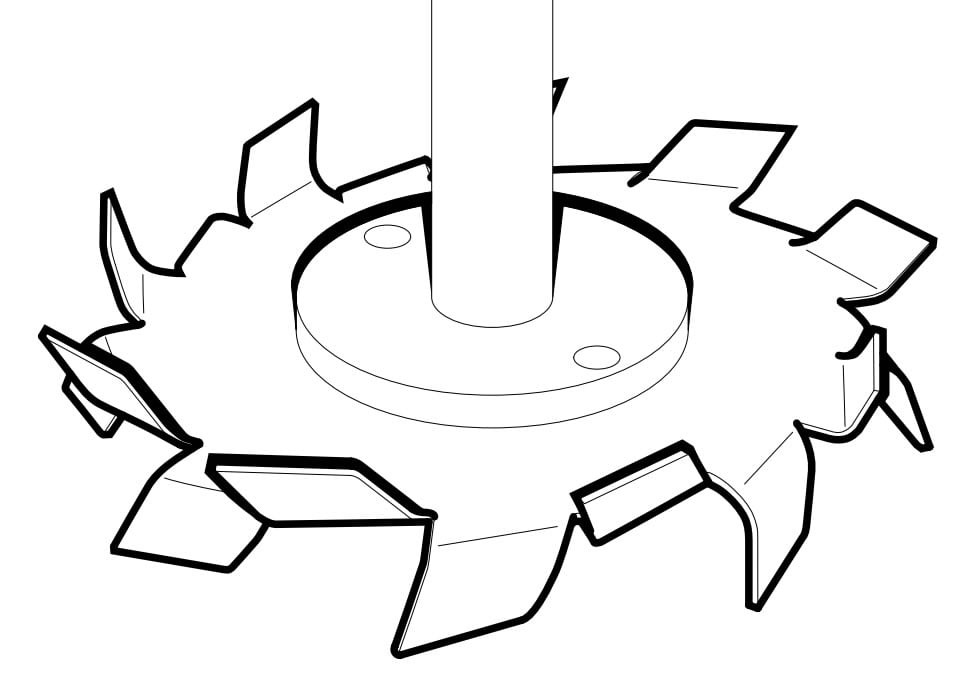
The Cowles impeller, often spelled “cowless” and also called a toothed disc or disperser blade, is a disc with teeth bent alternately up and down. At high speed it creates a very intense shear zone at the rim while product is drawn in from above and below and thrown towards the walls. It has the widest range in our line-up: 300 to 3,000 rpm. In dispersers the disc tip speed matters more than rpm (see sizing below).
- Viscosity: from thin liquids to pastes of a few tens of thousands of cP, as long as product keeps flowing back to the disc.
- Typical uses: dispersing pigments and fillers in paints and inks, fast powder dissolution, breaking agglomerates.
- Strengths: very high shear from a simple, easy-to-clean geometry.
- Limits: low pumping, so large tanks need a second circulation impeller; high power draw at top speed.
Straight-blade Rushton turbine
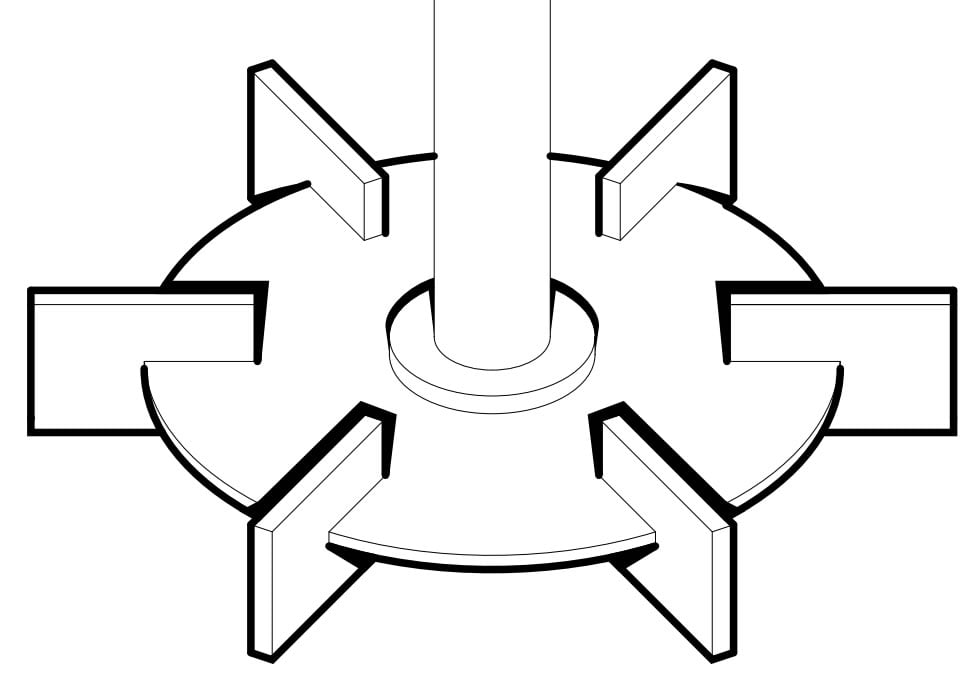
Six flat vertical blades on a disc. The disc stops gas sparged from below escaping up the shaft and forces it through the blades, where it is broken up. It runs from 300 to 1,400 rpm.
- Viscosity: low to medium, below about 5,000 cP.
- Typical uses: gas-liquid dispersion, reactions needing high mass transfer.
- Strengths: high local turbulence, well-documented behaviour.
- Limits: high power number; needs baffles; inefficient for plain blending.
Emulsifier impeller
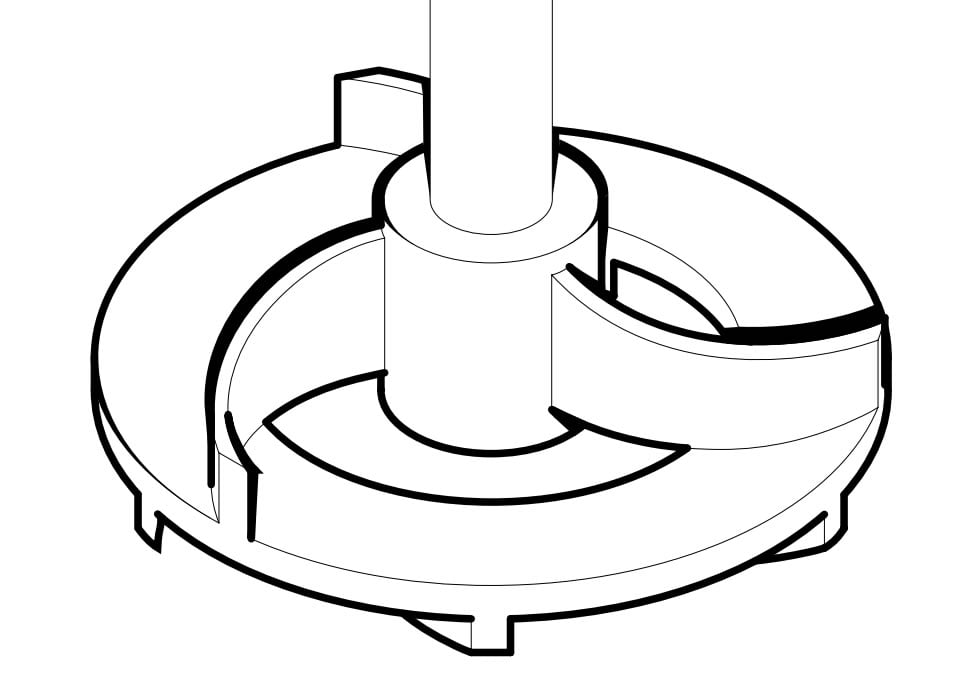
Curved vanes inside a toothed ring: liquid enters at the centre, is accelerated and leaves through the ring, where it is sheared hard and repeatedly. It runs from 500 to 2,000 rpm.
- Viscosity: low to medium.
- Typical uses: emulsions of immiscible phases, fine and stable dispersions.
- Strengths: smaller, more uniform droplets than an open impeller.
- Limits: modest circulation; more sensitive to coarse solids.
Folding-blade (movable-blade) impellers
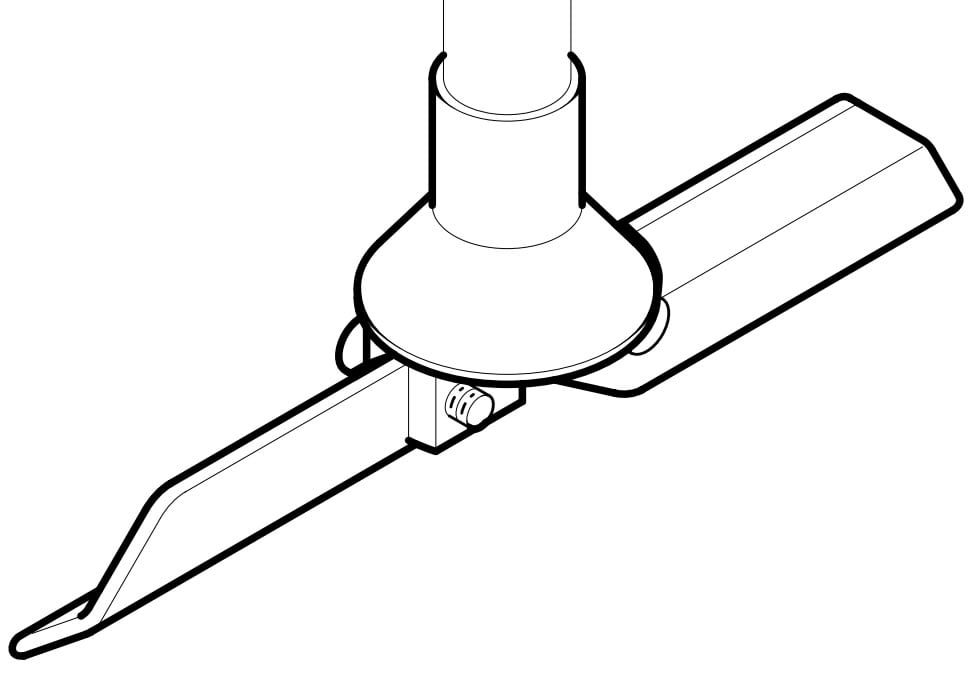
Folding-blade agitators are built for containers with a small opening, such as IBC totes and drums. The blades are pinned to the hub: in the usual arrangement they hang along the shaft when stopped, pass through the filler neck, then swing open as the shaft turns and work at full diameter. Our datasheets list the movable-blade impeller in the fast range (300-1,500 rpm) and, as a four-blade version, in the slow range (up to 400 rpm).
- Viscosity: low to medium.
- Typical uses: re-mixing additives and reagents in IBCs, re-suspending settled solids.
- Strengths: working diameter larger than the opening; one agitator can serve several totes.
- Limits: the hinge needs checking with solids-laden or crystallising fluids.
Pitched-blade turbine and modular impeller

Four flat blades set at an angle, usually 45°, give mixed flow with an axial bias. It is the workhorse of slow agitators: the pitched-blade turbine and modular pitched-blade impeller run from 10 to 380 rpm. The four-blade impeller also comes with straight blades when more radial action is needed.
- Viscosity: up to about 10,000 cP.
- Typical uses: flocculation, neutralisation, polyelectrolyte make-up, plating baths.
- Strengths: versatile; several impellers can be stacked in tall tanks.
- Limits: draws more power than a high-flow impeller for the same flow.
High-flow four-blade impeller
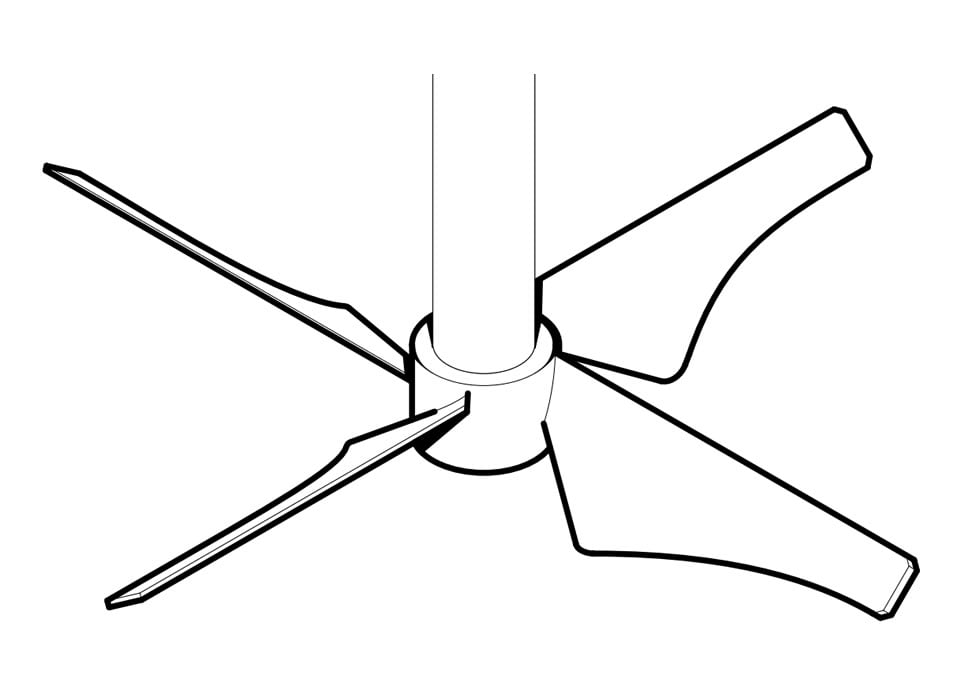
Profiled blades, wide at the root and tapering to the tip, designed to move the most volume with the least shear. It runs from 10 to 380 rpm on the EVRK, EVRL and KVRL ranges and the LRO side-entry mixer.
- Viscosity: low, best below about 1,000 cP.
- Typical uses: large tanks, solids suspension, flocculation where flocs must not break.
- Strengths: low power number, so smaller gear motors.
- Limits: loses effectiveness as viscosity rises; unsuited to dispersion.
Anchor impeller: gate anchor and anchor with paddle
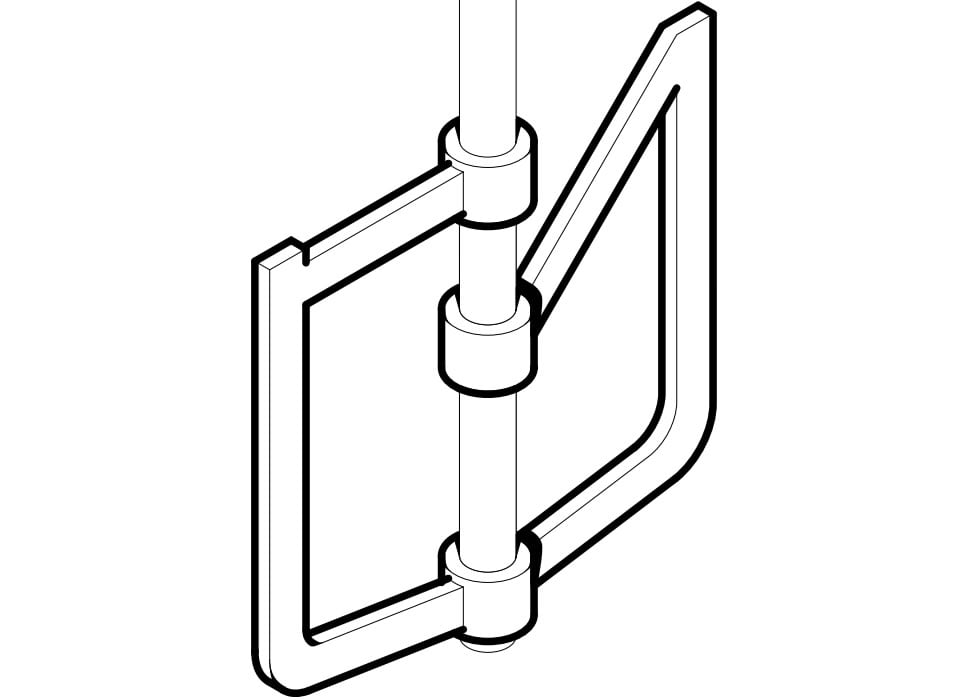
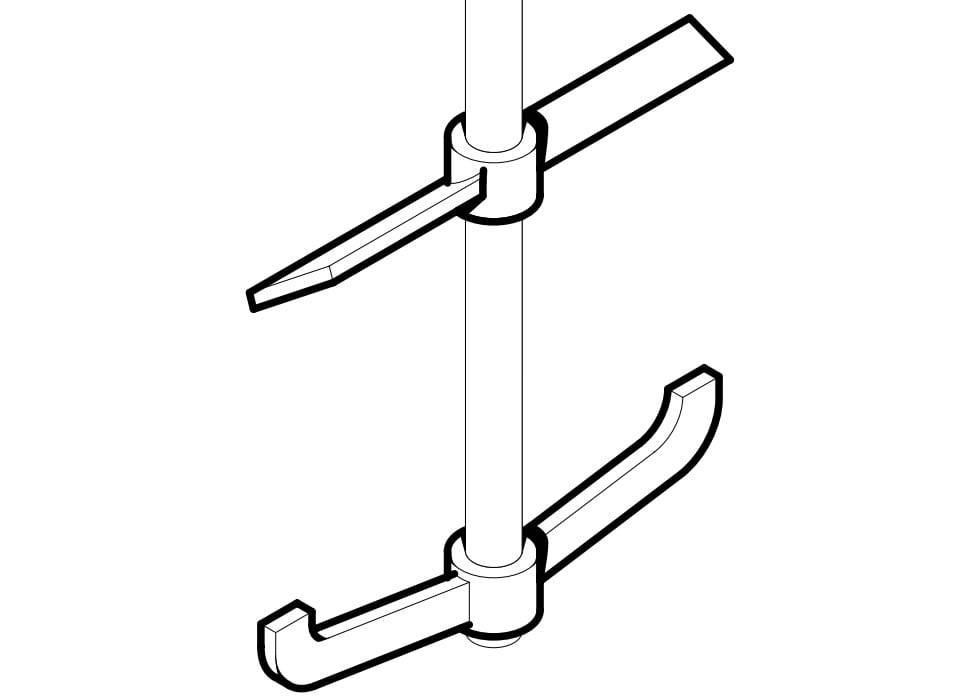
The anchor follows the tank profile close to wall and bottom, turns slowly (5-56 rpm on our datasheets) and moves the whole batch by drag. The version with a paddle adds an upper arm that improves vertical turnover, the weak point of a plain anchor.
- Viscosity: high, from 5,000 to over 50,000 cP.
- Typical uses: resins, gels, thick sludges, jacketed tanks.
- Strengths: moves the whole volume; improves heat transfer at the wall.
- Limits: poor vertical exchange without extra paddles; high torque.
Scraper impeller
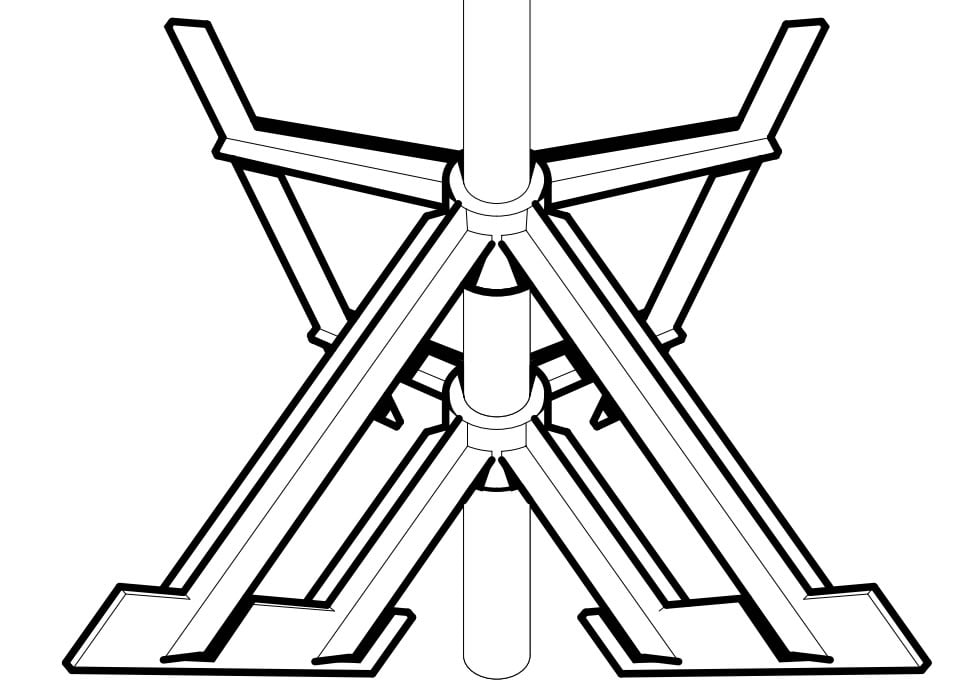
The scraper takes the anchor idea to its limit: arms and shoes work almost in contact with bottom and walls, removing product that sticks, settles or crystallises. We design scrapers to order around the tank and the product.
- Viscosity: high, or products that build deposits.
- Typical uses: fouling products, sludges that compact, wall-heated tanks.
- Strengths: clean walls and bottom, steady heat transfer.
- Limits: shoe wear; high power and starting torque.
Impeller comparison table
| Impeller | Flow | Indicative viscosity | Speed (Nuova Darimpianti datasheets) | Typical applications |
|---|---|---|---|---|
| Three-blade marine propeller | Axial | Up to 2,000-3,000 cP | 500-1,500 rpm | Dilution, neutralisation, water treatment |
| Cowles (cowless) disc | Radial, very high shear | Thin liquids to pastes | 300-3,000 rpm | Pigment dispersion, powder dissolution |
| Rushton turbine | Radial | Below 5,000 cP | 300-1,400 rpm | Gas dispersion, reactions |
| Emulsifier | Radial, high shear | Low-medium | 500-2,000 rpm | Emulsions, fine dispersions |
| Folding blades | Mixed | Low-medium | 300-1,500 rpm (fast); up to 400 rpm (slow) | IBCs, drums, narrow openings |
| Pitched blade / modular | Mixed, mainly axial | Up to about 10,000 cP | 10-380 rpm | Flocculation, polyelectrolyte, plating |
| High-flow four-blade | Axial | Below about 1,000 cP | 10-380 rpm | Large tanks, solids suspension |
| Anchor (gate / with paddle) | Tangential | 5,000 to over 50,000 cP | 5-56 rpm | Resins, gels, jacketed tanks |
| Scraper | Tangential with wall scraping | High or fouling | Custom design | Products that foul or settle |
Sizing basics: D/T ratio, tip speed and power number
The D/T ratio
D is the impeller diameter, T the tank diameter. Typical values: 0.2-0.35 for marine propellers, 0.25-0.4 for Cowles discs and Rushton turbines, 0.3-0.5 for pitched-blade and high-flow impellers, 0.9-0.98 for anchors and scrapers. Too small a D/T leaves dead zones; too large, on a fast impeller, sends power soaring.
Tip speed
The velocity of the blade tip:
v = π · D · N / 60
with v in m/s, D in metres and N in rpm. A 150 mm Cowles disc at 3,000 rpm reaches about 23.6 m/s, typical for dispersers; a 1.5 m anchor at 20 rpm about 1.6 m/s. Tip speed is the most direct indicator of shear and the figure to watch on thermoplastic impellers, which tolerate lower tip speeds than steel.
Power number and power draw
In turbulent flow, in a baffled tank:
P = Np · ρ · N³ · D⁵
with P in watts, ρ in kg/m³, N in revolutions per second and D in metres. Np depends on geometry: about 0.3-0.5 for marine propellers and high-flow impellers, 1.2-1.5 for a 45° four-blade turbine, about 5 for a Rushton.
Example: a 0.2 m propeller at 900 rpm (15 rev/s) in water, Np = 0.35: P = 0.35 × 1,000 × 15³ × 0.2⁵ ≈ 380 W. A Rushton of the same size at the same speed takes over 5 kW. Doubling speed multiplies power by 8, doubling diameter by 32, and power scales with density: in concentrated sulphuric acid (about 1,840 kg/m³) the same agitator draws nearly twice as much as in water. The motor is then chosen with a margin over this figure. In laminar flow the formula no longer applies in this form: anchors and scrapers are sized on torque. The link between viscosity and flow regime is covered in fast vs slow agitators.
Impeller materials for corrosive service
Choose the material for the worst product the impeller will see, at the highest temperature. On our fast ranges impellers come in AISI 304-316 stainless steel or in PP, PVC or PVDF; on the slow ranges also in PE-HD, and on the KVRL they can be ebonite-coated.
- PP: dilute acids and alkalis, plating baths, water treatment, up to 80-90°C.
- PVC: stiff and economical, but limited to 60°C.
- PVDF: concentrated acids, strong oxidisers, up to 100-120°C.
- AISI 304-316: with compatible fluids, for the highest tip speeds.
Our thermoplastic impellers are machined from solid block on CNC centres, free of moulding stresses and well balanced. For the chemical comparison see PP vs PVC vs PVDF: choosing the right material for chemical pumps and agitators.
Matching impellers to fast, slow and side-entry agitators
Fast agitators. On EV/EV-G and EVK the standard impeller is the three-blade marine propeller. The EVL range, with a single or double bearing lantern, and the KVL also take the straight-blade turbine, emulsifier and Cowles disc: these are the machines to choose when the impeller draws more power or runs at high tip speed.
Slow agitators. The EVR range, with the shaft keyed directly to the gearbox, carries the four-blade impeller with pitched or straight blades; EVRK and EVRL add the high-flow impeller and a lantern for medium and high loads. The KVRL, built for heavy loads, can carry 2 to 4 two-blade or four-blade impellers on one shaft, the answer for tall tanks or variable levels.
Side-entry agitators. The fast LVO takes the propeller, straight-blade turbine, emulsifier or Cowles disc; the slow LRO takes the four-blade impeller with pitched, straight or high-flow blades. Side entry suits large tanks and helps avoid a central vortex.
Frequently asked questions
What is the difference between a Cowles (cowless) impeller and a Rushton turbine?
Both produce radial flow. The Cowles disc concentrates very intense shear at the rim and is designed to disperse powders and pigments at high tip speed. The Rushton has flat blades on a disc, spreads turbulence more evenly and is the classic choice for dispersing gas into a liquid.
What are folding-blade agitators?
Agitators whose blades are hinged at the hub, so they fold to pass through a narrow opening and open as the shaft turns. They are mainly used to mix IBC totes and drums, where a rigid impeller of the required diameter would not fit through the filler neck.
Which impeller should I use for a very viscous fluid?
Above roughly 5,000-10,000 cP, small fast impellers only move the liquid around them. Use an anchor, possibly with an upper paddle, or a scraper if the product sticks to the walls. They run slowly, our anchor from 5 to 56 rpm, with gearboxes sized on torque.
Can I fit more than one impeller on the same shaft?
Yes, it is standard in tall tanks. The KVRL range takes 2 to 4 two-blade or four-blade impellers. Dispersion processes often pair a shear impeller, such as a Cowles disc, with an axial circulation impeller, to be assessed case by case.
Plastic or steel impeller?
It depends on the fluid and the tip speed. With acids, alkalis and oxidisers, PP, PVC and PVDF avoid corrosion; with compatible fluids and very high tip speeds, AISI 304-316 steel gives more mechanical margin. Often the answer is a coated steel shaft with a thermoplastic impeller machined from solid.
Conclusion: start from the flow you need
Choosing between agitator impeller types starts with one question: what has to happen in the tank? For circulation, look at axial impellers (marine propeller, pitched blade, high-flow); for shear, at radial ones (Cowles disc, Rushton, emulsifier); for thick products or fouling walls, at anchors and scrapers. Then check D/T, tip speed and power, and choose the material for the most aggressive fluid.
Choosing an impeller for a new agitator, or replacing one that underperforms? Nuova Darimpianti’s engineering team in Flero (Brescia, Italy) has been designing and building agitators and impellers in PP, PVC, PVDF and stainless steel for corrosive fluids since 1970, including custom designs. Send us your fluid, viscosity, volume and tank geometry: contact us for a no-obligation technical consultation.