Solid Block CNC Machining: Why CNC-Machined Thermoplastic Pumps and Agitators Outperform Moulded Components
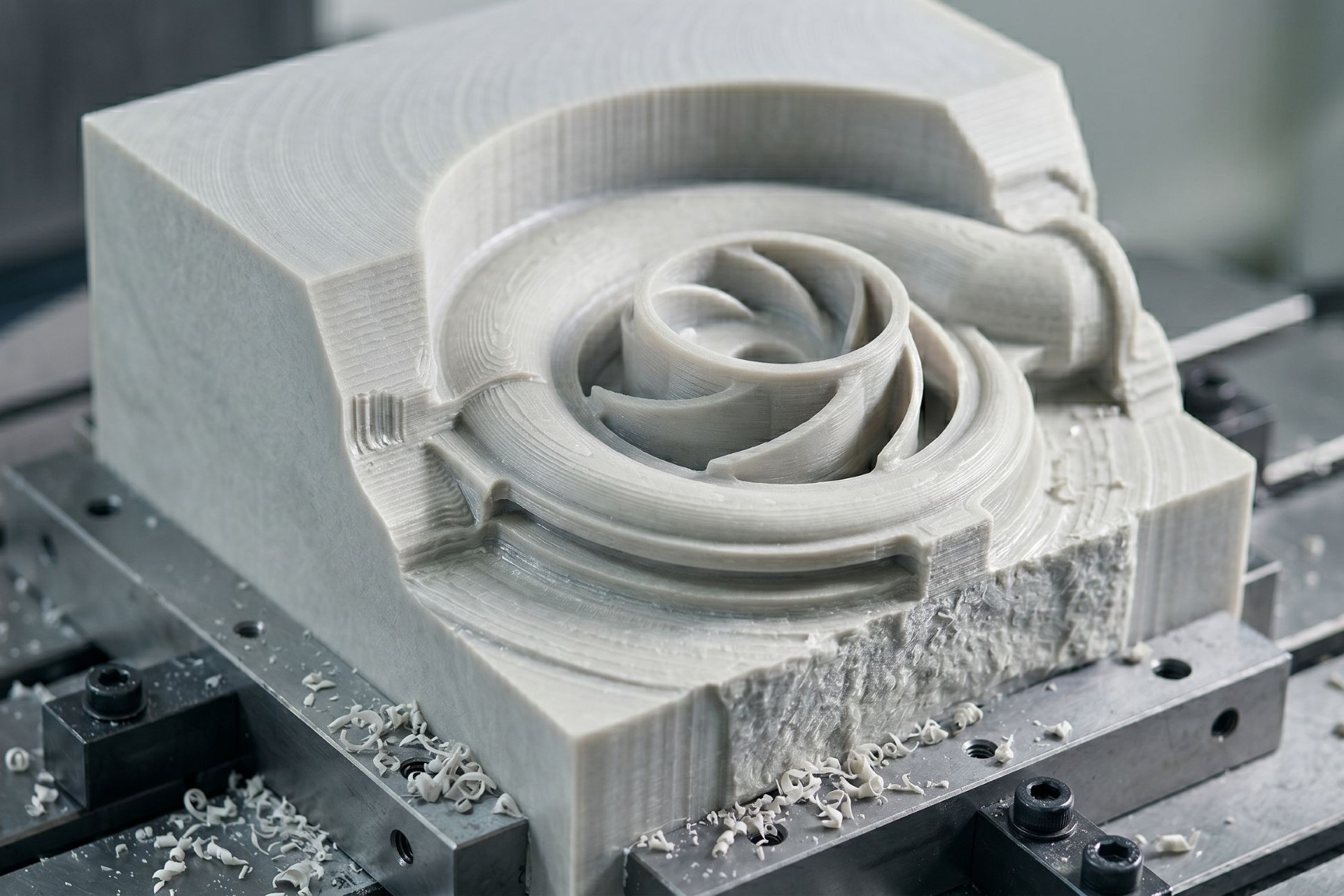
There are two fundamentally different ways to manufacture a thermoplastic pump body, impeller or agitator component. The first is injection moulding: molten polymer is forced under pressure into a steel mould cavity, cooled rapidly, and ejected as a finished part. The second is solid-block CNC machining: a certified, stress-relieved block of extruded or pressed thermoplastic is clamped on a CNC machining centre and the final geometry is cut directly from the solid material, one tool path at a time.
The vast majority of manufacturers in the chemical pump industry choose the first path. Injection moulding is faster per unit, cheaper at volume, and allows the production of thousands of identical parts from a single mould. It is the standard process for consumer products, automotive components and commodity fittings. For those applications, it works well.
But chemical pumps and agitators are not commodity products. They operate in concentrated acids, aggressive solvents and oxidising environments at elevated temperatures. They run continuously for years. A single failure — a cracked pump casing, a fractured impeller, a corroded agitator shaft — can shut down a production line, contaminate a batch, or cause an environmental incident. In this context, the manufacturing process is not a back-office detail. It is a technical decision with direct, measurable consequences on performance, durability and total cost of ownership.
Nuova Darimpianti machines every pump body, impeller and agitator component from solid thermoplastic blocks on 3-axis and 5-axis CNC machining centres. Every part, across every product line — from the PMC-1 horizontal centrifugal pumps to the KVRL slow agitators. No injection moulding. No compromises on material integrity. This article explains why, and what it means in practice for the engineers who specify and operate this equipment.
Injection moulding vs solid-block CNC machining: the technical differences
To understand why the manufacturing method matters, it is necessary to examine what happens to the polymer during each process — at the molecular level.
How injection moulding affects the material
In injection moulding, thermoplastic granules are heated to a molten state (typically 200–280 °C depending on the polymer) and injected into a mould cavity at pressures of 500–1,500 bar. The molten polymer fills the cavity from the gate — the narrow injection point — and flows outward until it meets the far walls. As the material contacts the cold mould surfaces, it solidifies rapidly from the outside in.
This process introduces several structural characteristics into the finished part:
- Frozen-in stresses. The outer layers of the part solidify and contract while the core is still molten. The differential cooling creates residual internal stresses that remain permanently locked into the material. These stresses are invisible and unmeasurable by simple inspection, but they are always present.
- Anisotropic molecular orientation. As the molten polymer flows through the mould, the long-chain molecules align preferentially in the direction of flow. The finished part has different mechanical properties in different directions — stronger along the flow direction, weaker perpendicular to it.
- Weld lines and flow fronts. Where two advancing flow fronts meet (around cores, pins, or where the cavity geometry splits the flow), the material does not fuse completely. These weld lines are planes of weakness — they have significantly lower tensile strength and impact resistance than the surrounding material.
- Gate marks and flow irregularities. The gate area — where molten polymer enters the cavity — experiences the highest shear rates and the most rapid temperature changes. The material in this zone has different crystallinity and stress levels from the rest of the part.
- Micro-porosity. Especially in thicker sections, the differential cooling can create microscopic voids (vacuum bubbles) within the part as the core material contracts during solidification.
- Dimensional tolerances. Standard injection moulding achieves tolerances of approximately ±0.3–0.5 mm, limited by mould wear, shrinkage variation and process variability.
For a pump casing that will spend five years immersed in hot sulphuric acid, every one of these characteristics is a potential failure mechanism.
How solid-block CNC machining preserves material integrity
Solid-block CNC machining starts with a fundamentally different raw material: an extruded or compression-moulded thermoplastic block. These blocks are produced by European specialist suppliers under controlled conditions — the polymer is heated uniformly, formed slowly, and cooled gradually over hours or days. The resulting block is stress-relieved, homogeneous and isotropic: its molecular structure is uniform in all directions, with no preferential orientation, no weld lines, and no residual stresses.
The CNC machining process removes material from this block without altering its molecular structure. The cutting tools shear away chips at the surface while the bulk material remains at ambient temperature. There is no melting, no rapid cooling, no pressure-induced orientation. The finished part retains the full integrity of the starting block.
The key advantages of this approach:
- No internal stresses. The finished part is stress-free, exactly as the starting block was.
- Isotropic properties. Mechanical strength, chemical resistance and thermal expansion are identical in all directions.
- No weld lines, flow fronts or gate marks. The part is machined from a monolithic block — there are no planes of weakness.
- No micro-porosity. The dense, homogeneous block structure is preserved throughout the part.
- Dimensional tolerances of ±0.05–0.1 mm. Modern CNC machining centres hold tolerances an order of magnitude tighter than injection moulding.
- Unlimited geometry. Part geometry is defined by the CNC program, not by a steel mould. Complex internal passages, deep undercuts and non-uniform wall thicknesses that would be impossible or prohibitively expensive to mould can be machined directly.
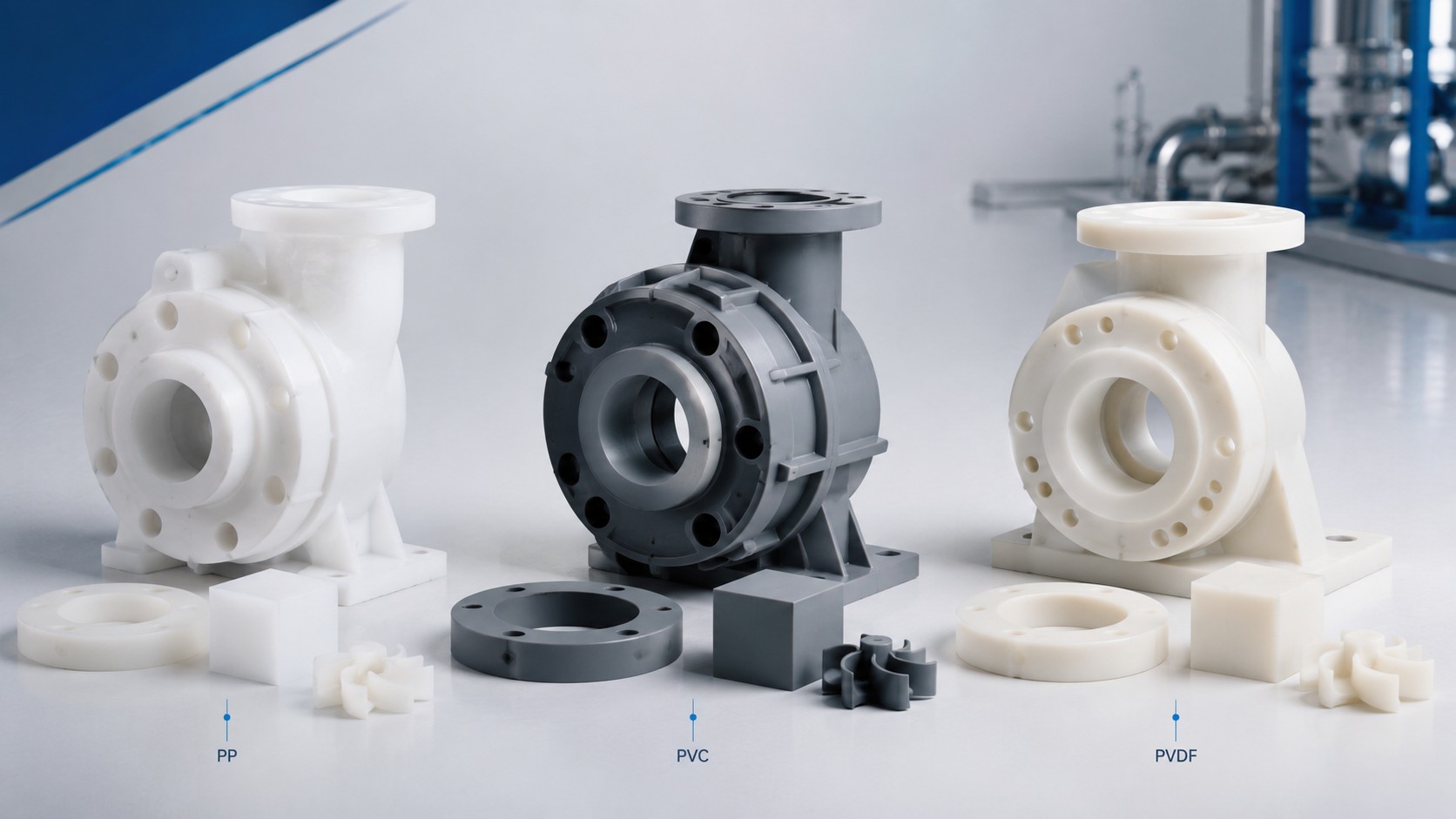
The starting material quality is critical. Nuova Darimpianti sources all its thermoplastic raw materials — PP (polypropylene), PVC (polyvinyl chloride) and PVDF (polyvinylidene fluoride) — from certified European suppliers who provide full material traceability, batch certificates and mechanical property documentation.
Measurable technical advantages of solid-block CNC machining
The structural differences described above translate into specific, quantifiable performance advantages in the field. These are not theoretical benefits — they are observed consistently across thousands of installations in chemical plants, surface treatment facilities and water treatment systems.
Freedom from internal stresses and Environmental Stress Cracking resistance
Environmental Stress Cracking (ESC) is the single most common failure mode for thermoplastic components in chemical service. ESC occurs when a polymer under mechanical stress is simultaneously exposed to a chemical agent. The chemical does not need to be one that attacks the polymer directly — it merely needs to accelerate the propagation of micro-cracks that initiate at points of stress concentration.
In injection-moulded parts, the frozen-in residual stresses provide exactly the conditions that ESC requires. The stressed molecular chains at weld lines, gate marks and surface layers are primed for crack initiation. When a corrosive fluid contacts these stressed regions, cracks develop and propagate — often within 12–18 months of installation, even when the polymer grade is theoretically compatible with the chemical environment.
Components machined from stress-free solid blocks are fundamentally resistant to ESC because the essential precondition — internal stress — is absent. The material is relaxed, isotropic and free from the oriented molecular chains that serve as crack initiation sites. In practical terms, this means that a CNC-machined PP pump casing operating in cyclic acid service at moderate temperatures will typically last three to five times longer than an equivalent moulded casing before showing any signs of surface degradation.
This advantage is particularly pronounced in cyclic thermal environments — processes where the temperature fluctuates repeatedly between ambient and operating temperature. Each thermal cycle in a moulded part adds stress as different regions expand and contract at different rates (due to the anisotropic molecular orientation). In a CNC-machined part with isotropic properties, thermal expansion is uniform in all directions, and cyclic loading produces far less fatigue accumulation.
Dimensional precision and hydraulic efficiency
The performance of a centrifugal pump is defined by its hydraulic curves — the relationship between flow rate, head (pressure) and power consumption at a given speed. These curves are designed by the engineer and depend critically on the exact geometry of the impeller, the volute casing and the clearances between rotating and stationary components.
In an injection-moulded pump, dimensional tolerances of ±0.3–0.5 mm mean that the actual impeller diameter, blade angle, blade thickness and tip clearance can deviate significantly from the design intent. The result is a pump whose real-world performance departs from its published curves — typically delivering lower head, higher power consumption, or both.
CNC-machined impellers hold tolerances of ±0.05–0.1 mm. The blade geometry matches the design precisely. The tip clearance — the gap between the impeller outer diameter and the volute casing — is controlled to within tenths of a millimetre. The practical consequences are measurable:
- Closer adherence to published pump performance curves. The pump delivers the head and flow rate that the engineer specified during system sizing.
- Higher hydraulic efficiency. Tighter clearances reduce internal recirculation losses. Precise blade angles produce the intended velocity triangles. The pump converts a greater fraction of shaft power into useful hydraulic work.
- Lower energy consumption. A pump that operates closer to its best efficiency point (BEP) draws less power for the same duty. Over the typical 5–10 year service life of a chemical pump running 8,000 hours per year, even a 3–5 % efficiency improvement translates into a substantial reduction in electricity costs.
- Reduced vibration and noise. An impeller that is machined to precise geometric symmetry is inherently better balanced than a moulded impeller with unavoidable dimensional variations. Less vibration means less bearing wear, less seal fatigue, less structural stress on piping connections, and a quieter operating environment.
These advantages apply across the full range of Nuova Darimpianti centrifugal pumps: the PMC-1 and PMC-2 horizontal series, the sealless HTM magnetic drive series, and the VSK vertical pump series along with the VGA, VL and EVFA-N vertical configurations.
Uniform chemical resistance across the entire part
In a moulded part, the chemical resistance is not uniform. The weld lines, where two flow fronts met during injection, have lower molecular entanglement and higher residual stress — they are the first areas to be attacked by aggressive chemicals. The gate region, with its different crystallinity and stress state, behaves differently from the bulk material. Surface layers, rapidly quenched against the cold mould, have different morphology from the core.
A CNC-machined part has the same molecular structure throughout its entire volume. The chemical resistance at any point on the surface is identical to the chemical resistance at any other point. There are no weak spots, no preferential attack zones, no weld lines where a crack can initiate and propagate. The published chemical resistance data for the base polymer — whether PP, PVC or PVDF — can be applied with confidence to every square centimetre of the finished part.
This is particularly important for components that handle mixed or variable chemical streams, where different regions of a pump casing or agitator blade may be exposed to different concentrations, temperatures or chemical species during the process cycle.
Design flexibility and custom manufacturing capability
Injection moulding requires a steel mould for each part geometry. A mould for a pump casing can cost tens of thousands of euros and takes weeks or months to manufacture. This imposes severe constraints: only standard sizes are economically viable, design changes require new moulds, and custom parts for one-off or low-volume applications are prohibitively expensive.
CNC machining eliminates the mould entirely. The part geometry is defined by a CAD model and a CNC program. Changing a dimension, adding a port, modifying a flange pattern or creating an entirely new variant requires only a change to the program file. There is no tooling investment to amortise.
This makes solid-block CNC machining the ideal manufacturing method for the industrial pump and agitator market, which is characterised by:
- Low to medium production volumes. Chemical plants need tens or hundreds of units, not thousands.
- High variety. Different process conditions require different pump sizes, materials, flange standards and connection types.
- Custom requirements. Non-standard port positions, special shaft lengths, unusual flange patterns, and process-specific modifications are routine in industrial applications.
- Rapid prototyping. When a new pump or agitator design needs to be validated, a CNC prototype can be machined and tested within days — a cycle that would take months with injection moulding.
Impact on pump durability in corrosive service
The combined effect of the advantages described above — freedom from internal stresses, dimensional precision, uniform chemical resistance — produces a dramatic difference in service life when pumps operate in aggressive chemical environments.
Consider a typical application: a horizontal centrifugal pump handling 30% sulphuric acid at 50 °C in a surface treatment plant, operating in a cyclic process where the temperature fluctuates between ambient and operating temperature several times per shift. This is a demanding but entirely common service condition.
An injection-moulded PP pump casing in this application typically begins to show visible surface cracking — the characteristic signature of Environmental Stress Cracking — within 12–18 months. The cracks initiate at weld lines and gate marks, propagate through the stressed regions of the material, and eventually lead to leakage and catastrophic failure. The pump is replaced, the process is shut down for the changeover, and the cycle begins again.
A CNC-machined PP pump casing from Nuova Darimpianti, manufactured from a stress-relieved extruded block, operating in the same conditions, will typically deliver 3–5 years of continuous service — and often significantly longer — before reaching end of life. The absence of internal stresses eliminates the primary crack initiation mechanism. The isotropic molecular structure resists thermal cycling fatigue. The uniform chemical resistance prevents localised attack.
The dimensional precision of CNC-machined components also extends the life of wear parts and seals. Seal seats machined to tight tolerances provide a more uniform compression of the mechanical seal faces, reducing leakage rates and extending seal life. Impellers that are geometrically balanced produce less vibration, which translates directly into longer bearing life and reduced shaft fatigue.
When the total cost of ownership is calculated — purchase price, installation, energy consumption, maintenance intervals, seal replacements, bearing changes and the cost of unplanned downtime — the CNC-machined pump is consistently the more economical choice. The higher initial component cost is recovered within the first replacement cycle of a moulded alternative, and every subsequent year of extended service represents a net saving.
Impact on agitators: precision where it matters most
The advantages of solid-block CNC machining are equally significant — and in some respects even more critical — for industrial agitators that operate in corrosive environments.
Uniform blade geometry for consistent mixing
The performance of an agitator depends on the precise geometry of its impeller blades: the blade angle, thickness, surface finish and pitch must be uniform across all blades to produce the intended flow pattern and mixing intensity. In a moulded impeller, dimensional variations between blades — caused by uneven flow filling, differential cooling and mould wear — produce an asymmetric flow field. The result is uneven mixing, dead zones in the tank, and inconsistent process outcomes.
CNC-machined impeller blades are cut to identical dimensions from the same block of material. The blade-to-blade consistency is limited only by the repeatability of the CNC machine, which is typically ±0.02–0.05 mm. The resulting flow field is symmetric, predictable and reproducible from one agitator to the next. This matters enormously in electroplating applications, where uneven agitation produces uneven plating thickness and surface defects.
Shaft straightness and concentricity
For vertical agitators — particularly the long-shaft models in the EVL and EVRL series that can extend several metres into deep tanks — shaft straightness is a critical specification. A shaft that is not perfectly straight creates a rotating imbalance that grows worse with length, producing vibration, bearing wear and, in extreme cases, shaft fatigue failure.
CNC turning and milling from a solid thermoplastic rod produces a shaft with straightness and concentricity that cannot be achieved by any moulding process. The shaft diameter is held to tight tolerances along its entire length, the bearing journal surfaces are machined to precise roundness, and the hub interface is concentric with the shaft centreline. The result is an agitator that runs smoothly even at the extended lengths required for deep-tank installations.
Hub precision and power transmission
The hub — the connection between the shaft and the impeller — must transmit the full motor torque without slippage, looseness or misalignment. A CNC-machined hub-to-shaft interface provides a precise fit that distributes the load uniformly, preventing the localised stress concentrations that can lead to fatigue cracking in moulded hubs.
Fume zone resistance
In many chemical tank applications, the most aggressive environment is not the liquid itself but the fume zone — the region above the liquid surface where concentrated chemical vapours condense on all exposed surfaces. Agitator shafts, shaft sleeves and the upper portions of vertical pump columns operate continuously in this zone. The uniform, stress-free molecular structure of CNC-machined components provides maximum resistance to the condensation attack, micro-cracking and surface degradation that are characteristic of fume zone exposure.
These advantages apply across the full range of Nuova Darimpianti agitators: the EV/EVK/EVL/KVL fast series, the EVR/EVRK/EVRL/KVRL slow series, and the LVO/LRO lateral-mount configurations.
The Nuova Darimpianti manufacturing process
Solid-block CNC machining is not simply a matter of buying a CNC machine and cutting plastic. It is a complete manufacturing philosophy that spans the entire production chain, from raw material procurement to final testing.
Certified raw materials
Every block of PP, PVC and PVDF that enters the Nuova Darimpianti facility in Flero (Brescia) comes from certified European suppliers with full material traceability. Each batch is delivered with documentation certifying the polymer grade, mechanical properties, chemical composition and production conditions. This ensures that the starting material meets the specifications required for chemical service — a level of traceability that is impossible with the commodity granules used in injection moulding.
3-axis and 5-axis CNC machining centres
The company operates a fleet of CNC machining centres ranging from 3-axis mills for simpler geometries to 5-axis machines for complex components such as volute casings, multi-blade impellers and contoured agitator blades. The 5-axis capability allows the machining of complex 3D surfaces in a single setup, eliminating the repositioning errors that would accumulate in a multi-setup process.
Quality control on every part
Because CNC machining is inherently a single-part or small-batch process, quality control is performed on every individual component — not on statistical samples from a production run. Dimensional checks, surface finish verification and visual inspection are carried out at multiple stages during machining and again after completion. This is a fundamental difference from injection moulding, where quality control is typically based on sampling from batches of hundreds or thousands of parts.
Assembly and testing
Finished components are assembled into complete pumps or agitators in the Nuova Darimpianti facility. Each assembled unit is tested before shipment: pumps are run on the test bench to verify performance against the published curves; agitators are checked for shaft runout, vibration and motor current draw. No unit leaves the factory without documented test results.
Full traceability
Every component can be traced back through its production history to the specific block of raw material from which it was machined. In the event of a field issue — which is rare but not impossible in the harsh environments where these products operate — the complete manufacturing history is available for root cause analysis.
Complete product range
This manufacturing process is applied across the entire Nuova Darimpianti product range: all horizontal pumps for corrosive environments (PMC-1, PMC-2, HTM), all vertical pumps (VSK, VGA, VL, EVFA-N), all fast agitators (EV, EVK, EVL, KVL), all slow agitators (EVR, EVRK, EVRL, KVRL), and all lateral agitators (LVO, LRO). There are no exceptions — no product line uses moulded components.
Frequently asked questions
What is the difference between a moulded and a CNC-machined pump?
An injection-moulded pump is made by forcing molten plastic into a steel mould under high pressure and cooling it rapidly. This process introduces internal stresses, anisotropic molecular orientation, weld lines and micro-porosity into the material. A CNC-machined pump is cut from a solid, stress-relieved thermoplastic block on a computer-controlled machining centre. The finished part retains the full integrity of the starting material: no internal stresses, isotropic molecular structure, no weld lines, and dimensional tolerances an order of magnitude tighter than moulding (±0.05–0.1 mm vs ±0.3–0.5 mm). The practical result is a component that is more resistant to chemical attack, more dimensionally precise and significantly longer-lasting in corrosive service.
Does solid-block CNC machining cost more than injection moulding?
The per-unit manufacturing cost of a CNC-machined component is higher than the per-unit cost of a moulded part produced in large volumes. However, the total cost of ownership tells a different story. CNC-machined pumps and agitators last three to five times longer in aggressive chemical environments, require fewer seal and bearing replacements due to superior dimensional precision, operate more efficiently due to tighter hydraulic tolerances, and eliminate the cost of unplanned downtime caused by premature failure. When these factors are accounted for across a typical 5–10 year service horizon, the CNC-machined equipment is consistently the more economical choice. Additionally, CNC machining requires no mould investment, making it far more cost-effective for the low-to-medium volumes and high variety that characterise industrial applications.
Which materials does Nuova Darimpianti machine?
Nuova Darimpianti machines three principal thermoplastic materials: polypropylene (PP), the most versatile and widely used, suitable for most acids, bases and saline solutions up to 80–90 °C; PVC (polyvinyl chloride), preferred for sodium hypochlorite service and applications below 60 °C; and PVDF (polyvinylidene fluoride), the highest-performance option for concentrated acids, aggressive solvents and elevated temperatures up to 120 °C. All three materials are sourced as certified, stress-relieved blocks from European suppliers with full traceability.
How long does a CNC-machined pump last compared to a moulded one?
In typical chemical service conditions — for example, handling 30 % sulphuric acid at moderate temperatures with thermal cycling — a CNC-machined PP pump casing will typically deliver 3–5 years or more of continuous service before showing signs of degradation. An equivalent injection-moulded PP casing in the same conditions commonly develops Environmental Stress Cracking (ESC) within 12–18 months. The primary reason is the absence of frozen-in residual stresses in the CNC-machined part: without internal stress, the #1 failure mechanism in chemical service — ESC — is effectively eliminated. For PVDF components in aggressive service, the life extension factor can be even greater.
Can Nuova Darimpianti manufacture custom parts?
Yes. This is one of the inherent advantages of the CNC machining process: because there is no mould, custom parts do not require tooling investment. Nuova Darimpianti routinely manufactures non-standard configurations — modified flange patterns, special port positions, extended shaft lengths, non-standard impeller diameters, bespoke mounting arrangements — based on customer specifications. Custom parts are machined to the same tolerances and quality standards as standard catalogue components, with the same material traceability and testing protocols. Prototypes for new designs can typically be produced within days, allowing rapid validation before committing to a production order. Contact the engineering team to discuss your specific requirements.
Conclusion
In an industry where the default manufacturing method is injection moulding, Nuova Darimpianti has made a deliberate and technically grounded decision to machine every pump and agitator component from solid thermoplastic blocks. This is not a marketing claim — it is a manufacturing reality that is verifiable in every part the company produces.
The advantages are measurable: freedom from the internal stresses that cause Environmental Stress Cracking, dimensional precision that delivers higher hydraulic efficiency and lower energy consumption, uniform chemical resistance with no weak points, and the flexibility to produce custom configurations without tooling investment. The result is equipment that lasts longer, performs better and costs less to own over its service life.
For engineers specifying pumps and agitators for corrosive environments, the manufacturing process should be a primary selection criterion — not an afterthought. The polymer grade matters. The pump sizing matters. But the way the component is made determines how long it will survive in the field.
Contact Nuova Darimpianti to discuss your application requirements, request a technical consultation, or obtain a quotation for CNC-machined pumps and agitators in PP, PVC or PVDF. Every component we manufacture is machined from a solid block — because in corrosive service, material integrity is not optional.